
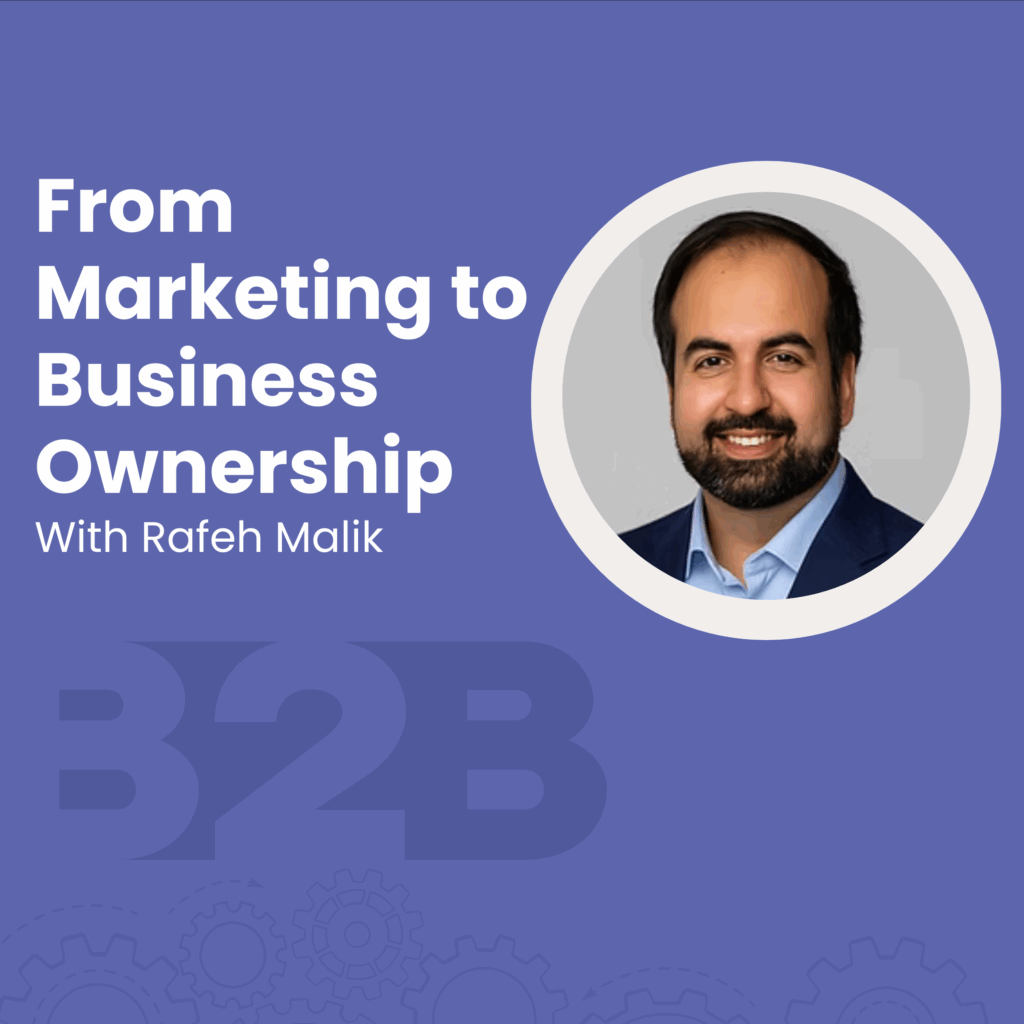
In this episode of B2B Marketing Methods, host Terri Hoffman, CEO of Marketing Refresh, sits down with Rafeh Malik, a seasoned marketing professional set to embark on a new venture as a business owner in Houston.
Rafeh discusses his diverse career background, including his education at Rice University, his journey through various industries, and his experiences in product marketing, corporate strategy, and nonprofit initiatives. The conversation delves into Rafeh’s aspirations to acquire a business in Houston, his criteria for selecting a business, and his strategic approach to business growth. He emphasizes the importance of understanding customer needs, leveraging digital marketing, and creating the right cultural fit.
Tune in for an insightful discussion on the transition from marketing leadership to small business ownership.
To learn more about Rafeh Malik, connect with him on LinkedIn at:
https://www.linkedin.com/in/rafehm
Or, email him at:
[email protected]
To learn more about Terri, connect with her on LinkedIn at:
https://www.linkedin.com/in/terrihartley/
To connect with Marketing Refresh, visit:
Full Episode Transcript
Introduction to B2B Marketing Methods
[00:00:00] Terri: Welcome to B2B Marketing Methods. I’m your host, Terri Hoffman, and I’m the CEO of Marketing Refresh. Let’s face it, embracing digital marketing is daunting. This podcast was created to make it more approachable. Join me as we talk to CEOs, sales leaders and revenue growth experts who will share lessons learned and tips from their own journeys.
[00:00:28] Guest Introduction: Rafeh Malik
Terri: Hi everybody, and welcome to another episode of B2B Marketing methods. I’m really pleased to have as my guest today, Rafeh Malik.
He and I are going to have a really exciting conversation. He is about to begin a new adventure in his career, and I’m going to let him tell you a little bit, more about that during our interview. Just to give you a little preview, we’re going to be talking about, his desire to identify and acquire, a new business in Houston. He’s got dreams of kind of taking that over and joining numerous [00:01:00] other members of his family to be a small business owner in Houston.
He’s has a really interesting background in the marketing field. He is a Rice MBA, which everyone in Houston, can definitely say that is like a huge accomplishment. I’m really pleased to have you here today. Thank you so much for joining me and taking the time.
[00:01:20] Rafeh: Absolutely.
Terri, it’s a pleasure. I really appreciate you reaching out and I’m excited about this conversation.
[00:01:27] Terri: Yeah, it should be fun.
[00:01:28] Rafeh’s Background and Career Journey
Terri: So let’s start with, you know, kind of a more in depth introduction. Why don’t you introduce yourself and give us a little bit of background.
[00:01:35] Rafeh: Absolutely. So I like to start this way.
So I grew up in 10 cities. My dad was in the military. We moved around in Asia, Europe, and obviously the last 12 years in the US when I came for my higher education at Rice. So yeah, it gave me a couple of skills. It’s given me adaptability skills, listening skills, trying to connect with all kinds of people, and that’s been my strong suit. As on the other side is my, kinda like my left, right brain has worked together [00:02:00] in that way is obviously I’m educated and all that good stuff. So, in terms of my background, I went to undergrad in Pakistan. I did, economics, mathematics. I had a dream, I wanted to be a marketing guy. I thought marketing was my ideal job, I had looked at a couple of folks who done marketing. So I interned in marketing in my first year of college, and then I was like out of college, that’s my dream job. Luckily I got that job, so I started my career in product marketing.
[00:02:28] Nonprofit Startup and Early Career
[00:02:28] Rafeh: I think I’ll just fast forward quickly, but I think from there I also, before I moved to the US I also started a nonprofit startup and that nonprofits very similar to unfortunate situation that is happening in Texas recently. There were floods that have impacted the Indian subcontinent and 30 million people were affected by that. Me and a couple of friends with my product marketing job, we solved for this problem, which is like the overhead cost of helping others, like through a not-for-profit is usually like 40%, 50%.[00:03:00]
We were like, how can we bring that down to 2% and give donations to the people who need it? So we raised $15,000 at the age of 23. The three dudes, 23-year-olds. We come from privileged backgrounds, like whatever you want to define those, but basically. We impacted almost 1000 families and basically gave them food, rehabilitation support, all that good stuff.
So one of the best things in my life and marketing was part of it, like word of mouth marketing. Digital was like very early, was emails. It was text messages. It was literally calling people like IVR marketing as well back in the day. I don’t know if you remember that, I used that in my actual first job as well.
[00:03:41] Transition to the US and Career Growth
[00:03:41] Rafeh: Fast forward came to the US, then got my MBA from Rice and then the last 10 years I’ve been on the East coast. I started my career at Verizon and then I worked in the media industry and the health care industry as well. All three industries I’ve done, like I moved out of marketing.
I wanted to become a general manager, like an old business. I had this [00:04:00] thought, my uncles were small business owners in the Houston area and I was like, can I do this? Do I need a lot of money for it? Do I need this da, da, da and idea? But lo and behold, over the last 10 years, I’ve done everything from strategy, business development, strategic partnerships, a little bit of marketing.
Now I’m basically at a moment in life. We just had our second kid, we have family in Houston, and I’m moving back to Houston after 10 years in the New York area.
[00:04:25] Founding Rafnum Partners
[00:04:25] Rafeh: I founded a company with the goal of buying one business in the Houston area. It’s called Rafnum Partners.
It’s rafnumpartners.com. And basically the goal is, is, hey, can we solve one business entrepreneur succession issue? They don’t want to sell to like a finance run private equity company. Maybe they want an individual with a family who can take over their business and continue the legacy of their business.
Yeah, that’s the hypothesis. I’ve been looking for the last 10 months.
[00:04:57] Terri: Wow. That’s pretty exciting. Can you think [00:05:00] back to kind of a certain point in your marketing career where you started to think a little bit bigger and beyond a marketing role, and you thought more about business management or business ownership potentially?
[00:05:13] Rafeh: I would say a lot of things to uncouple here in terms of business management. Yeah, obviously when you go to grad school at, a university like Rice, you get that exposure across different facets of what a business needs for, from a management perspective.
[00:05:29] Terri: Mm-hmm.
[00:05:29] Rafeh: I think that was one part of it, the education element. I think I came in with a preconceived notion. I want to get into marketing, actually. I did get into marketing. The first job outta business school was in marketing, in 2015. But I think I learned obviously a couple of things, my dad pushed me a lot towards finance.
I’ve never done finance, so I didn’t listen to him. But what that led down is, is there’s a lot of other facets of like, kinda like what you could do. So that’s what I’ve done. I would say a couple of inspirations is one of my uncles who is in the Houston area was [00:06:00] an immigrant and he has successfully built a lot of companies, actually bought companies, build companies in the Houston area. Like I actually lived with him for a few, when I was at Rice.
[00:06:09] Terri: Okay.
[00:06:09] Rafeh: So to save on, cost of living. But at that time I was inspired. I think one of my professors in the business school, shout out to Aldonto, he basically took, we had a course that was my favorite course in business school, so it already stayed with me.
And I’ll say one thing, Terri, I’ll tell you my top two. One was a soccer club manager and I like strategy and thinking and problem solving. So that, that was my first job. The second was being a small business owner of multiple businesses.
[00:06:35] Terri: Okay.
[00:06:36] Rafeh: So that’s the path I’m on. It’s unnerving, but it’s exciting.
[00:06:39] Terri: Yeah. Well, those would’ve been two very different paths. Are you a big soccer fan?
[00:06:44] Rafeh: I’m a huge soccer fan. Okay. My team is not doing that well, but I’m a huge soccer fan.
[00:06:49] Terri: I have a background in athletics. I played basketball for a number of years and I played in college and I have friends who coach at the college level now. And boy, that is like running a business.
[00:06:59] Rafeh: [00:07:00] Mm-hmm.
[00:07:01] Terri: There are a lot of analogies between those two different roles. So as you started to, go through that education process at Rice, it sounds like you came out still thinking, I really want to dive further into my marketing career, but that seed got planted with you about business ownership.
How did you kind of really make this leap? Like what were some of the, drivers for you to then make the transition out of marketing to where you are now?
[00:07:33] Rafeh: When you’re in school, you see a lot of different parts of the organization like getting trained, like you get courses and different things.
That was one part of it, but I was already fascinated with management consulting. So my first job out of marketing was actually becoming, internal management consulting, corporate strategy, which was you basically apply your business school education. This is back 2015-16. I got lucky. I believe I have a good way of connecting with folks, and that [00:08:00] helped me.
I networked into their organization as actually at Verizon. They were about to become a media company, which they miserably failed at, but they were about to acquire Yahoo and AOL, back in the day. So I was in the strategy team looking at those deals, like analyzing them, coming up with some like, analysis for our senior management.
So it was, oh, that sounds very interesting. It’s very much like problem solving. You’re trying to like hypothesize about which businesses to go after, which businesses to divest, it’s very broad and I wanted that education. And I think another thing I’ll say is, is on the business and ownership side, I’m an immigrant.
I didn’t realize this, like there can be ways, but for me, I needed to get all of that through. So now I’m a US citizen as of this year. So knew that was coming. So that kinda like timed with, Hey, should I start a business here, go somewhere else, buy a business. That’s where it led to right now is like there, there’s a personal side of it.
There’s a like personal reasons of, we just had a second kid, so we want to move [00:09:00] back to Houston. And then Houston, economically is good. Personal connections are strong. I think there’s a hypothesis I have, you told me before in my, our pre-call,
[00:09:09] Terri: Mm-hmm.
[00:09:09] Rafeh: Like you loved Houston. I know people love Houston, but a lot of people don’t have a good perception of Houston for some reason. I think my hypothesis is there’s some folks their kids don’t want to live in Houston because New York sounds very cool, or Miami sounds cool.
So hopefully I can find one of those to buy their business or run their business for them. Something like that. Yeah,
[00:09:29] Business Acquisition Goals and Criteria
[00:09:29] Terri: Well, let’s talk a little bit more about what you’re looking for in a business. Are there certain industries that are the most appealing to you and why?
[00:09:38] Rafeh: Yes. So I would say in order of prioritization if you will is healthcare services. I worked at the largest health tech company in the US at least Teladoc Health. Basically that’s like an Uber for doctors and patients. So I have that healthcare
background. I have a few folks [00:10:00] from that company who are willing to be my board of advisors, put in a little bit of capital as well. Healthcare services also is a need, it’s not a want. So that’s one. Because of my personal background, there’s a buyer fit, if you will, like a fit with me.
The second is commercial services. So right now, I’ve been on the board of my HOA for the last three years, which is a townhouse community, 140 units. And we just did our largest transformation. And I saw from the other side, these commercial services are like, you can call them residential, but they’re basically, they’re working with our HOA, so they’re kinda like customer commercial services, like these roofing companies, these siding like landscaping, these like what they call nowadays, like in the social media, boring businesses. I was on the other side of it as a board member. So I learned a lot and I’m like, very interesting. I could increase value by adding some AI, some systems thinking the work I’ve learned some strategic partnerships.
So I think the second is to answer your question is, is commercial services that I’m interested in. A lot of [00:11:00] this is tied to the quality of the revenue with those.
And then the third is value added distributors. So healthcare services, commercial services or business B2B services, as they call it in the marketing world.
And then the third is, value added distributors. So, for example, an IT service that resells technology, but also adds value. Those are the three kinds of businesses I’m looking at.
[00:11:22] Terri: Okay. Well I just, from living in Houston for almost 30 years, you should have a lot to pick from. Lot of substance in those three categories in Houston.
What, I guess aside from like, if you look at the softer side of owning a business. What are some of the more like cultural things that you’re after that would be important to you in conversations and kind of your own evaluation and assessment if it’s the right fit for you?
[00:11:51] Rafeh: Great question, Terri.
I think one. I hope it’s owner, like it’s founder led.
[00:11:57] Terri: Mm-hmm.
[00:11:58] Rafeh: So somebody who built it from [00:12:00] scratch, they’ve put their emotion into it, they’ve put a lot of effort into it, and I want to respect that and I want to take their legacy and continue that. That’s the first thing I would say. And that reflects, I mean, if you think of like public company study.
There’s like two types of companies. There’s a founder led companies and there’s like manager led companies. And there is a stark difference if I talk to people who’ve done it, you’re a founder yourself.
[00:12:22] Terri: Mm-hmm.
[00:12:22] Rafeh: The heart and soul you’ve put into the business where you started scrappiness and then, so I think that’s the one thing with founder led.
The second thing I would say is, is like the culture they’ve built is reflected in the employees and their kinda like turnover. Like turnover is a good metric, but basically even before that, you can, even though I won’t be able to connect with the employees, but turnover and looking at the employees and seeing like, Hey, these guys have been here for X years.
That means this person has built a very, not just a durable business, but also a business where the employees are happy enough to stay on. There are a lot of opportunities for people to move around. Houston has been growing a lot, so that [00:13:00] reflects on the culture of the organization. I think as long as those two things are there, there’s obviously the financial metrics and the operational metrics that I’m looking at, but those would be the two first ones I would say.
[00:13:11] Terri: Yeah. Okay. I think what would be challenging is having all of the metrics and those qualities be a great fit and then there isn’t a cultural fit between your management style and your kind of leadership skills, and then the rest of the team and that particular founder too, right?
Like that has to feel like a good fit for everyone. Especially if it’s already a successful business. You’re trying to figure out how to, carry on that success and continue to build on that so that there is a legacy that founder can be proud of, in that transition.
[00:13:46] Rafeh: Yep. So absolutely important.
[00:13:49] Terri: This is a little bit challenging to answer until I guess you have that specific business, but what are some of the things that you’re contemplating as far as business growth strategies? Like [00:14:00] how do you look at, at revenue growth?
What are some of the key things that you begin to think about when you’re developing a revenue growth strategy?
[00:14:12] Rafeh: Absolutely. I mean, look, it is tricky to answer that question without knowing the business, the business model, the landscape. With that said, I think, some of the biggest levers are like obviously pricing. Like would we, one, I think in terms of like, can I leverage, and you’re going to love this, Terri, like, can I leverage digital marketing?
Can I leverage, word of mouth marketing, like how do I improve the marketing profile of the organization, if you will? Through starting for the brand and then the why or why this company exists all the way to, tactically how do we put that message out there and in the most cost. I’ve built models. I’ve actually analyzed businesses.
The organic would be a lot of can we do grassroots marketing, digital marketing? And then on the inorganic side is through being in the industry, playing the [00:15:00] game.
Are there other smaller companies out there that we can go and grow through.
[00:15:05] Terri: Right. Yeah. Well, and I think, the first one that you said, I really don’t think that’s boring to our audience pricing, right? Because it’s a very commonly overlooked way to grow revenue is assessing how you’re priced in the market, right?
Are you three years behind on price increases? Are you a little too aggressive? How does that fit into the context of your overall market? And sometimes that can be one of the simplest marketing strategies is reassessing your pricing. And it may even be,
[00:15:33] Rafeh: Absolutely
[00:15:34] Terri: not just the actual price itself, but how that pricing is structured and delivered is it, put into a certain package, how is it bundled?
All of those things are pretty important.
[00:15:45] Rafeh: Oh yeah, I can say something terri is, is my favorite book. I mean, it’s been a long time I read it, is “Predictably Irrational” by Dan Ariely. I don’t know if you’ve, have you, have you read the book?
[00:15:55] Terri: No, I haven’t. I like the title though.
[00:15:58] Rafeh: It’s basically a human behavior [00:16:00] book like that. I’m a student of human behavior, psychology. One of the examples is how humans are irrational about buying behavior when it comes to certain things. For example, you could have a free thing, like with a certain price, like how humans can get irrational when something’s free, that’s the crux of one of the examples, which is tied to organization here, because you see a lot of sales taxes, you see discounts. Maybe the actual ticket price is different than the actual paid price. This is a very classic model in the SaaS business where they wine and dine and then like cut the discount, but the actual price is much higher and the actual like what you pay is much lower and that human behavior to buy. So like humans are irrational. We are not machines, we are not AI.
We are HI. So how do you use that irrational behavior, be it in the commercial space, be it in the consumer space to entice customers or entice people to buy your service. I think that’s, yeah, just [00:17:00] been my favorite book. I met the, the writer in Houston actually, I think. It was awesome. He’s a very interesting guy.
[00:17:06] Terri: Yeah, I bet I, I’ll have to check that out. I’ll put that on my book list.
[00:17:10] Marketing Strategies and Customer Focus
[00:17:10] Terri: As far as like, digital marketing, again, this is because of your background in marketing, I’d really love for you to talk about this. When you’re developing a marketing strategy, what are the things that you really need to understand and feel like you have a solid grasp of before you would begin marketing? Like, what are those core important pillars, and I’m talking about things like strategy, you know, branding, messaging.
What, what are those core things for you that are your starting points that you have to understand?
[00:17:44] Rafeh: First thing is you start with the customer. Like every marketing person is going to tell you start to understand who your customer is. What is the problem that they have that you’re trying to solve?
So you start there. I come from a background where I started with product marketing. So my [00:18:00] first job was, in the telecom industry. You had these value added services like ringtones, ring back tones back in the day.
And like the big thing we were solving is, is you want to find your micro niches or your segments. So for me, I like to think that’s my quantitative side of my brain is, hey, so this is the problem. This is the customer profile. Now these are the nuances of these customers.
[00:18:22] Terri: Mm-hmm.
[00:18:22] Rafeh: So how do we go after certain, with what kind of messaging do we do? Is there a pricing difference for the different segments? I think that, that’s very high level of what I would say the marketing strategy entails. It starts with the customer and the problem.
[00:18:34] Terri: Yeah. Okay. Great. I love that answer.
The reason I ask it is because I see very often in my job that gets skipped. Right, you immediately start thinking about, oh, I should be on LinkedIn, or I need to have a new website, or I should start ads. And yeah, you may need to do all of those things, but if you don’t really start with that foundation of understanding who your customer is, what their challenges are, and how [00:19:00] your product or service addresses their problems, it doesn’t matter what platforms you’re on.
Because you’re not going to be connecting, you’re not going to create that connection. With people who are ultimately, they’re doing research, they’re trying to make logical decisions, but they’re usually emotional decisions at the end of the day, right?
[00:19:19] Rafeh: Yes. Yeah.
That’s why that book, Predictably Irrational.
And then the other I’d say, “Start with Why,” is a good book.
[00:19:25] Terri: Oh yeah.
[00:19:26] Rafeh: I’m a book nerd.
[00:19:26] Terri: I love that book.
[00:19:27] Rafeh: So, Start with Why as another book, and I think the, which what you said resonated and brought that thought in mind is, what I’m doing at Rafnum Partners is basically the why is I’m solving one business owner in Houston’s succession issue, which they can go sell.
Obviously, I’m going, it’s going to be a fair price. It has to work out for everybody. But the succession issue is the why, and you have a lot of people who have that succession issue. They don’t have a kid, they’re unhealthy or the kids don’t want it or the employees don’t want the business and like or they’ve just done this for 20 years and they’re like, oh my God, now [00:20:00] I want to do something else.
[00:20:00] Terri: Yeah.
[00:20:01] Rafeh: So I think, the why is very important. A lot of people are like, oh no, go do this, da da da, and then da da. My website even it starts with the why.
[00:20:08] Terri: I love that, it immediately tells the person reading it if it’s right for them or not.
Because if they aren’t dealing with a succession issue, you may want to just meet them to be a nice person, but that’s not a fit for you, right? So it’s better if they’re able to determine really quickly, this is not the guy I want to talk to. And for you to do the same, like I only want you to talk to me if you’re having a succession issue.
And you’re looking to solve that. And then we can talk and get to know each other, on a more detailed level and determine if we’d even be the right fit. Because we still might not be the right fit, but that’s the problem I’m trying to solve.
[00:20:45] Rafeh: Oh yeah. Absolutely. And look, I’ve talked to dozens of owners by now.
I mean, I’ve been on it for the last 10 months. I was doing this part-time and now I’m like going to go full name as moved to Houston. But it’s exactly what you said. It’s like you have to, like, [00:21:00] also, I’m looking at the just one business, and I’m talking to like maybe a hundred, 200, 300, 400 business owners, in the Houston area.
So at the end just the fit needs to be between like me and them, but also between like our values and our plan for the future. Obviously there can be changes like after a change of ownership, but I need to align with them on the vision they have and like that matters to me because for me, I’ll be so much dependent on them. Like the first 12, 18, 24 months, I would like them to be part of the journey, for sure.
[00:21:36] Terri: Yeah.
[00:21:36] Rafeh: So that’s another thing I’m kind of like pitching to people, like, rather than, oh, a company comes in, buys you out, and you’re out. I’m like, no, we, we can partner. And I’m, I think I’m a nice enough person. I have a bad sense of humor according to my wife.
[00:21:49] Terri: That’s great. I mean, I like the approach. You’re willing to go through hundreds of conversations to get to the right fit. You’re not in a hurry. You’re looking for the right opportunity.
[00:21:59] Rafeh: Mm-hmm.
[00:21:59] Terri: Although I’m [00:22:00] sure you would not be upset if that right opportunity happened tomorrow.
[00:22:05] Rafeh: No, please.
[00:22:07] Terri: Yeah.
[00:22:08] Rafeh: Absolutely.
[00:22:09] Challenges and Reflections on the Journey
[00:22:09] Terri: What has been, I guess, as you go through this process, what’s been something that has been surprising to you?
[00:22:15] Rafeh: It’s very lonely, so I’ve solved for that. Like I have a cohort, like there’s a couple of platforms you can find people. That’s the one part of this journey. You are getting hundreds of nos or you are saying no to hundred times before you get to one yes. And you don’t realize that until you’re in motion. Oh my God. Every day is different. It’s not as structured as a job.
You start this time to da da which doesn’t very helpful for me because we just had a newborn and like my wife is obviously recovering. So I think the structure, no structure, creating that structure, the getting those nos, that’s the one thing. But I, I have never been this excited since in school, since I was in school.
My business school tech club president, board of a nonprofit in Houston. I was doing like admissions interviewing. I was doing a lot of things when I was in school in Houston. And then you, you do a corporate job, you work here. It’s, [00:23:00] God bless them for giving me a job and a visa and a green card and citizenship and all that good stuff, but it’s, it’s really boring, trust me. Like, I mean, after 10 years I’m like, I want to do something. So, one quote I have is, I think my mom once shared it with me many years ago. The purpose of life is a life of purpose. My purpose at least wasn’t to just be working in one company, which has X thousand people and doing that for many years with a y dollar of paycheck and then retire.
I just never thought that would be my purpose. So I think I’m finding my purpose in this way, in this journey as well. And that’s been a beautiful thing.
There’s one side and then there’s the other side.
[00:23:38] Terri: Well, that you just described exactly what it’s like to own a business and that happens like 70 times a day where you flip on both sides of those coin, but that’s what makes it kind of invigorating too.
Right? It’s really fun.
[00:23:53] Conclusion and Contact Information
[00:23:53] Terri: I think that’s a wonderful way to close our time. And before we do that, I would love for you to explain to people [00:24:00] who would like to have a conversation with you. Maybe they have a business and they’re in that issue right now. Or they are in a position or have the type of business where they could connect you to people.
How do you want people to reach out to you? What’s the best way for them to get in touch?
[00:24:17] Rafeh: One is, is obviously go to my website. It has my contact details, so it’s R-A-F-N-U-M partners.com. It lays out my background, like why I’m doing this, what I’m doing.
My email is [email protected], that’s how you can reach me. Please reach out to me. In terms of, any business owner who wants to talk, obviously they save on not going through a broker like, or like a M&A intermediary. If they’re interested to sell, like we can have a 30 minutes, there’s no commitment or anything like that, like 20 minutes even can be very efficient call.
Like we can sign a non-disclosure and then have a conversation. If there’s anybody who knows folks like M&A attorneys or CPAs who consult with or help other business owners, they want to have a conversation, happy to have that as well.
[00:25:00] So yeah, so those, those would be the two things I would say.
[00:25:02] Terri: That’s awesome. Well, good. Best of luck. I’m looking forward to learning more about the business that you acquire and how that whole journey kind of wraps up for you, and then the new journey begins.
[00:25:12] Rafeh: Terri, a shout out to you. Thank you so much for having me on the podcast. Absolute pleasure.
[00:25:17] Terri: You’re welcome. That was a really fun conversation.
Thank you for listening to B2B marketing methods. Please be sure to follow us on your favorite podcast channel and leave us a review. We’d love to hear from you and connect. You can find me on LinkedIn or visit our company website at marketingrefresh.com.