
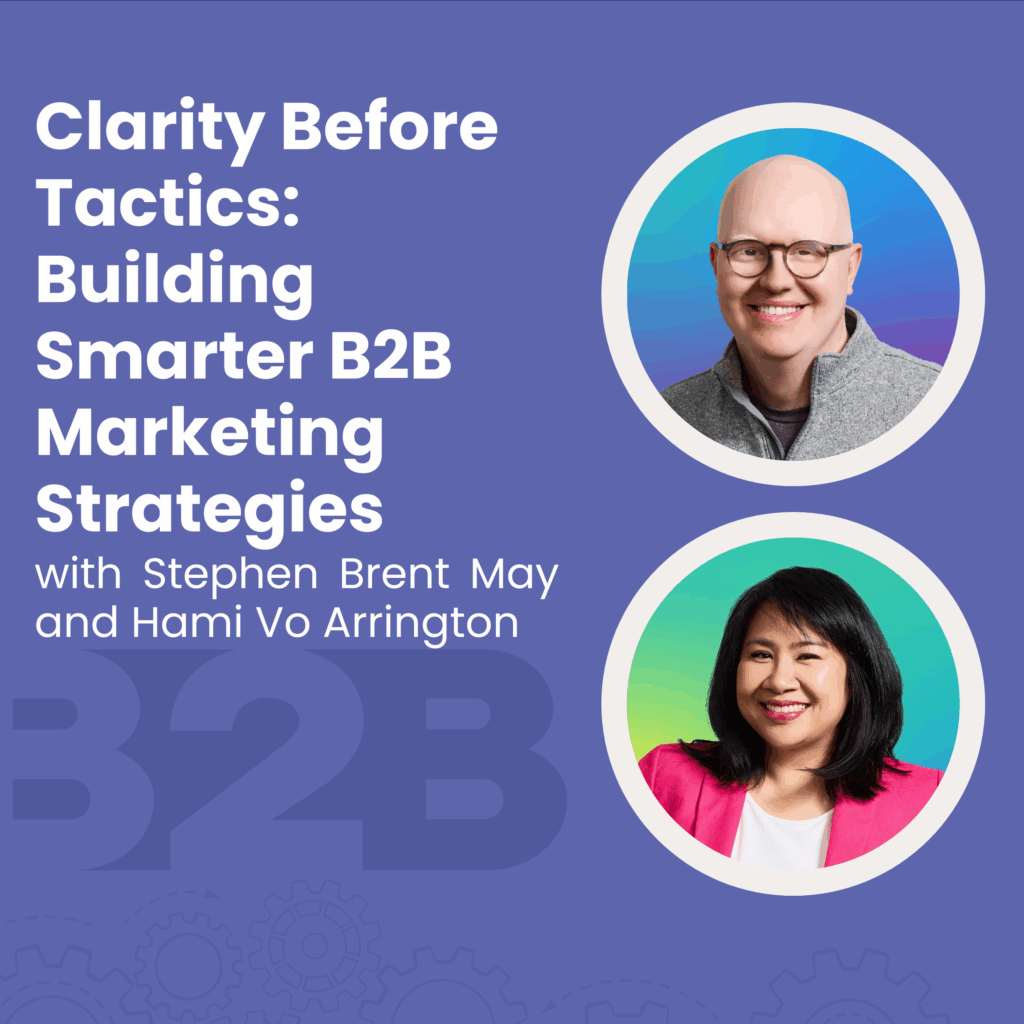
In this episode of B2B Marketing Methods, Terri Hoffman sits down with One Foot Over co-founders Stephen Brent May and Hami Vo Arrington for a transparent, highly relatable conversation about what B2B companies often get wrong about marketing strategy—and how to fix it.
Together, they unpack the meaning behind their mantra “Clarity Before Tactics” and explore why defining goals, aligning with sales, and understanding your buyers must come before launching campaigns.
You’ll also hear candid stories about client expectations, marketing trauma, Houston’s business landscape, and what happens when organizations skip discovery and jump straight into execution. This episode is a practical guide for any leader who wants to make smarter, more intentional B2B marketing decisions.
What You’ll Learn in This Episode:
- What “Clarity Before Tactics” really means in the B2B marketing landscape
- How marketers can prevent wasted budget by defining goals before choosing tactics
- Why discovery and upfront clarity are essential for long-term success
- The difference between a strategy, a plan, and a calendar
- How marketing supports long sales cycles in industrial and tech-driven B2B markets
- The importance of intentional decision-making during lean budget years
- How to keep marketing momentum even when you can’t invest in full-scale strategy
- Managing client expectations and pushing back with purpose
- Using sales teams as a resource for real-time buyer insight
- The role of marketers as translators between leadership priorities and execution
To learn more about Stephen Brent May, connect with him on LinkedIn at: linkedin.com/in/stephenmay
Or, email him at: [email protected]
To learn more about Hami Vo Arrington , connect with her on LinkedIn at: linkedin.com/in/hamiarrington
Or, email her at: [email protected]
To learn more about Terri, connect with her on LinkedIn at: https://www.linkedin.com/in/terrihartley/
To connect with Marketing Refresh, visit: MarketingRefresh.com
Full Episode Transcript
[00:00:00] Terri Hoffman: Welcome to B2B Marketing Methods. I’m your host, Terry Hoffman, and I’m the CEO of Marketing Refresh. Let’s face it, embracing digital marketing is daunting. This podcast was created to make it more approachable. Join me as we talk to CEOs, sales leaders and revenue growth experts who will share lessons learned and tips from their own journeys.
[00:00:28] Terri Hoffman: Welcome to another episode of B2B Marketing Methods. I have two special guests today. We have, Hami Vo Arrington and Steven Brent May. The two of them are co-founders for a marketing agency that’s based in Houston, Texas called One Foot Over.
They’re going to tell us their fun origin story here in a few minutes, but first off, welcome to this episode. Thank you both for joining me today.
[00:00:52] Hami Vo Arrington: Thanks for having us, Terri.
[00:00:53] Steven Brent May: We’re excited to be on talking with another agency owner.
[00:00:56] Terri Hoffman: Yeah. We can share some fun stories.
[00:00:59] Steven Brent May: Oh, yeah.
[00:00:59] Terri Hoffman: So we’re going to just to kinda give the listeners a little bit of a preview, we’re going to be talking a lot about strategy. I think it’s so important they have, an important phrase that they’ve started to use as their mantra called
clarity before Tactics. we’re going to talk about what that means. We’re going to talk about the components of a marketing strategy, why it’s so important to have those elements outlined before you dive into spending money on tactics and things that can go wrong. We’re going to talk about some, hopefully some fun examples that we can both think of if we haven’t ahead of time.
I’m sure we’ll think of them in real time, but the whole conversation is going to be about marketing strategy and why it’s so important. So, thanks again, for joining me and I guess let’s get started with some basics. I’d love for you each to tell a little bit more about yourselves and your background in the marketing industry, and then how you started One Foot Over.
[00:01:51] Hami Vo Arrington: Yeah. So I’ll start. so when I was young, my family had,
[00:01:57] Terri Hoffman: Hami, what? No, you’re still young. What’re you talking about?
[00:02:00] Hami Vo Arrington: When I was younger.
[00:02:02] Terri Hoffman: Okay. Okay. Younger.
[00:02:04] Hami Vo Arrington: Okay. My family had a marketing agency, a marketing advertising agency, so I kind of grew up in it. and when we would have dinner together, after school, what we would talk about would be marketing problems and client issues,
rather than talking about what I learned in school. So it’s really something that I grew up, you know, talking about and learning about, for a long time. And then, I went to school, got my, undergraduate degree in PR, worked in, the agency for a little while, my family’s agency. And I said, you know, I really don’t, want to do this for the rest of my life, this particular type of marketing.
And so I went back and got my MBA and I kind of did a realignment and went into B2B marketing. When I got my degree in B2B market or in, in marketing, I moved to Houston and I didn’t know anybody in Houston and so I joined a MA and, I think that that’s probably where Steven can pick up the story.
Yeah.
[00:03:02] Steven Brent May: Yeah. So, I did not grow up in a family of marketing agency owners, so my story’s a little different. I went to college with full intentions of becoming a lawyer and had probably the worst advisor in college because my advisor said, you have to major in political science if you want to get into law school,
that’s the only path. Which is 100% not true, but I took my first political science class, loved it second semester, took the next political science class and the professor said, if you took 1 0 4 in the first semester, it has nothing to do with the remainder of your political science career. This class is what the rest of your career and political science will be like.
And I hated that class and I was like, I cannot do this for four years and I talked to my advisor and they were like, yeah, unfortunately you really need to major in political science to go to law school. So, the next semester I decided to try a few different things. So I took economics, I took a journalism class, I took advertising basics and fell in love with the advertising class.
I loved the people, I loved the course. And so the next semester I was like, well, I’m going to take more classes in this, like in this school, and just really fell in love with it. So that’s how I ended up in marketing was just, you know, what I thought was going to be my career path turned out not to be my college career path.
so I started out in hospitality marketing in boutique hotels and cut my teeth, kind of doing a lot of email marketing. And then when the economy turned in, like the, the late aughts got moved to a sales position to keep my job moved to Houston eventually, and I was like, you know what? Maybe now’s the time to go to law school.
Took the LSAT and was going to shift my career. But right around that same time, I got another job and was introduced to a AMA, became a volunteer. So the American Marketing Association kind of kept me on this marketing path, kept me out of law school Hami and I met at a conference for AMA board members in Chicago.
So here we are, both from Houston, both living in Houston, but end up meeting at a conference in Chicago and decided when we get back to Houston, let’s get happy hour together. So I won’t, I won’t jump into the details because you can actually hear it on our podcast in full details. But fast forward a few years later, we co-chaired,
[00:05:33] Terri Hoffman: apparently I have to put the link in the comments to that now.
So that’ll happen. I mean, got it.
[00:05:38] Steven Brent May: Hashtag marketing. So we volunteered together on an awards gala worked so well together. We were both looking for the next step in our career and we decided, you know, what if we try to make something out of this as business partners? And so that’s how One Foot Over started and that was almost nine years ago.
[00:05:57] Terri Hoffman: Mm-hmm. That is awesome. I, I’m excited because I had never heard that story before, so that was, that was fun to hear after all the years of knowing the two of you. I’m glad you explained what AMA is as well, because I think even. You know, it’s, it’s not just for agency employees or agency owners, it’s such a great organization for anybody who’s in the marketing industry. We’ve got employees who are involved, and I have been involved in the past. it’s a really great way to get connected, I think, to other people. And then, you know, of course there’s tons of learning resources and career resources and things like that, but it’s so good for just getting around other marketers who are going through the same things that you’re going through.
[00:06:38] Steven Brent May: Right. I mean, and it’s, you know, I’ve always said like, similar to Hami, I didn’t have a network when I came to Houston, and that was where I found a marketing network. But also at the same time, like that’s where you find friends as an adult. once you’re at school, it’s hard to make friends and these are people that we’ve got common interest with, and so a lot of the people end up becoming lifelong friends.
[00:07:00] Terri Hoffman: yeah. I think you’re right. Obviously every industry has their little niche, niche conversations, but there are nobody, there’s nobody who can geek out and really talk about their industry like marketers together. We get to hang out all night talking about stuff. So that’s a lot of fun.
Let’s start by having you introduce who One Foot Over is. What do you do?
[00:07:22] Hami Vo Arrington: Yeah, so we are all B2B, we only serve B2B markets. We, started out trying other things like B2C and we decided that that is actually not for us. because we are too strategic. We really wanna think things through, from start to finish.
And so it felt like B2C wasn’t the right place for us. And so we just, it just wasn’t our, favorite thing. And the two markets that we have, Really landed on our tech and industrial manufacturing. Those are really, that’s really where we shine, in Houston. I think that that’s really a great place to be.
I mean, that’s why Marketing Refresh is there as well and so, yeah, that’s really where we shine and that’s also where we can, we’ve seen that we can make the biggest impact with the strategy that we, strategies that we put in place.
[00:08:06] Steven Brent May: Now I wanted to add, because I think that’s important,
Also why we appreciate you having us on Terri, because people might ask the question, well, if you guys are similar, why are you talking to each other? And our philosophy is, and we know it’s yours because we’ve talked about this before, is like there’s so much room for good marketing and there’s enough business for all of us.
And so we actually do better when we work together versus looking at other agencies as our competitors. Like who does that? So.
[00:08:36] Hami Vo Arrington: Yeah, I think that sharing information is really how marketing gets better. One of the reasons why Steven and I got along so well and the reason we started One Foot Over was because we saw that the marketing in Houston was a little bit behind, the rest of the country at the time.
And so we said, you know what? We are, we are of the same mindset. Let’s try to make Houston marketing better. That was really our driving force and it’s still our driving force today of making marketing better. That is really our, our goal is to make good marketing. Yeah. So it has carried through.
[00:09:10] Terri Hoffman: it sounds really simple, but I can appreciate how hard it is to achieve that.
Not because we don’t know how to market, but there are, a lot of noise in our space and that really makes it hard for the people who are trying to buy our services. there’s everything from gimmicks to people who use the exact same language as us that don’t actually take the same approach.
[00:09:30] Hami Vo Arrington: Mm-hmm.
[00:09:31] Terri Hoffman: And it makes it very confusing as the buyer of our services to figure out, you know, who to align themselves with. And I can like, as actual competitors of each other, we have never that I can recall gone into a situation where we’ve been up against each other or pitted up against each other because Houston is a massive market.
[00:09:50] Steven Brent May: Yeah, I can think of situations where we’ve actually referred business to each other versus.
[00:09:55] Hami Vo Arrington: Yes.
[00:09:56] Terri Hoffman: Exactly it’s really important to each one of our companies to find fit, right. And find the appropriate relationship, the appropriate fit, alignment across so many different areas.
It’s now, I think the third biggest city. In the country if it’s, if it’s not already, it’s like really close to surpassing Chicago.
[00:10:16] Hami Vo Arrington: Mm-hmm.
[00:10:17] Terri Hoffman: And something that I’ve always found interesting about Houston is that, as large as it is and as much, as large of a business community, as it has, it’s a very sales driven
[00:10:29] Terri Hoffman: like B2B economy. And I think that happens in oil and gas pretty naturally. It happens in healthcare, it happens in multiple sectors in the Houston market, and it’s so important to me as a mission for our agency to help people understand the importance of marketing and how that supports sales and works together with sales.
What, what do you guys think when you think about that topic?
[00:10:55] Steven Brent May: I agree. One of the things someone told me when I first moved to Houston, they’re like, as large as Houston is as a city, they’re like, it operates very much like a small town. And I didn’t believe that at first. But it’s once you get involved, like in the marketing community, specifically like everybody knows everybody and the marketing community is huge.
Whether you’re like agency, corporate side, healthcare, oil and gas. Like you meet somebody and you’re like, oh, oh, you know this person? Yeah. I worked with them 20 years ago at this company and you know, it, it operates like very much like a small town of a group of people. And I imagine that other industries are the same.
If you’re in oil and gas, like I know a lot of the people, you know, know each other even though they’re huge, you know, enterprise corporations there. So I think that’s a really interesting thing about Houston was like being the third or fourth largest city in the country, like how small it can feel.
[00:11:54] Terri Hoffman: Mm-hmm.
[00:11:56] Hami Vo Arrington: Yeah. Yeah. I, yeah, I agree. We we’re always bumping into somebody. It’s actually odd whenever, you know, somebody comes up and we’re like, what agency is that? I’ve never heard of that before. That’s really interesting. but to address your question about, the sales people. I mean, we work hand in hand with the sales team.
You know, we are there to support them and that’s the message that we send because it’s absolutely true. That is the reason why we exist, so that we can help the salespeople. In B2B marketing we don’t do any sales. We can’t sell anything for the companies we work with, because there is a complex buying process.
You cannot buy anything without talking to somebody. You can’t just go online and hit, buy or check out. The way that we look at it is we are here to help the salespeople, help them not only get the lead in the door, but also help them, move the lead along. Right?
I mean, a lot of the companies we work with, their sales cycles are between, you know, like 18 months. There’s one client that we work with. Their sales cycle could be 10 years. Wow. And that is so long. one sales person, or a sales team just really cannot keep on top of checking in with those leads.
And so marketing has to come in and help them move it along help them keep top of mind. So yeah, we, if you don’t get the buy-in from your sales team and your marketing is just not going to work.
[00:13:19] Terri Hoffman: And I’m finding more often than not in the last few years, sales is really pushing for there to be more marketing support and really working on getting their leadership teams to buy in.
we track data all the time about how marketing can influence sales and impact revenue growth and brand awareness and so I believe in it, it works.
Mm-hmm. Right.
[00:13:41] Steven Brent May: Yeah. And I think those words, like the words are important that you said, like influence and impact, because I, I always say like revenue is not a marketing metric.
[00:13:50] Terri Hoffman: Mm-hmm.
[00:13:51] Steven Brent May: Revenue is a sales metric, but the ability to impact revenue is a marketing metric. The ability to influence pipeline is a marketing metric, but revenue as a number itself is a sales metric, not a marketing metric.
[00:14:05] Terri Hoffman: Yeah, right. Pretty important distinction. So when we were preparing for this episode, you know, Steven, you and I were talking about your, a mantra you’ve been using lately. So why don’t you explain it, like, say what it is and give us some background on it.
[00:14:19] Steven Brent May: Yeah, so Hami and I were, sitting in our office just talking about things and kind of challenges and you know, one of the things that kept coming up is the idea of strategies and working with clients and why are we doing that?
Like, what is the purpose? And always asking our team that question, if a client says, well, we want to do an email campaign in Q3, pausing to say, well what are you actually trying to achieve with the email campaign? Because maybe it’s not just an email campaign or maybe there’s something else that we should be looking at instead.
And so, you know, we found ourselves asking that question constantly. Like, well, what are they trying to achieve? What is the goal here? Like, what is the end result we’re trying to get to? And we kind of came to this term, and I forget it may have been, chatGPT or something where we first saw it, I forget how the words ended up in front of us, but it was this clarity before tactics and we were like, you know what?
That really makes a lot of sense. That’s exactly what we’re saying. We just didn’t have the words around it. And that stuck with us. It’s this idea that unless we know where we’re trying to go or what the destination is. We don’t know how we’re supposed to get there or we can’t come up with a path to get there.
So at the end of the day, the concept is really about just having an end goal in mind before you even get started.
[00:15:43] Terri Hoffman: Yeah, because we get approached with those kinds of, I think it’s funny because most of the time when we’re start a relationship, clients tell us, we want you to challenge us, we want you to push back.
And I think that makes for a healthy relationship on both sides of the relationship. but when you start pushing back, it can become a little bit uncomfortable, right? It’s like, no, I like the CEO just asked us to get this email out in the fourth quarter. But you know, our job as an agency is to like really protect their investment in marketing and really make sure, like if you’re going to spend that money, we want it to work.
because if it doesn’t work that, that’s on us ultimately, and that’s part of the evaluation of the relationship with us. so we’re going to challenge it because we wanna make sure we stay engaged and keep you as a client, but we also wanna make sure that that’s happening because it worked, right? Like if we’re doing things that, that move, you closer to the metrics you’re trying to achieve, that builds on the relationship.
[00:16:42] Hami Vo Arrington: Mm-hmm.
[00:16:43] Terri Hoffman: Yeah, so I think it’s important to push back and ask the why and the why and the why. Even though we probably drive people crazy sometimes. I think it’s important.
[00:16:51] Hami Vo Arrington: Yeah, I, I think that, so in our experience, I, or in my experience, it’s been, I, I think that our, the clients that we work with, they actually, they do appreciate that, right?
Appreciate of why, why are we doing this, so that we can understand, they want us to have full clarity as well. You know, I know that we, we talked about this clarity before tactics, but I mean, it’s, they appreciate this clarity, but at the same time, I’m going to acknowledge, Terri, this C-suite factor.
Right? So whenever somebody asks for something, then that might just be the reason that, oh, my boss asked for it and it has to get done now because he, he or she specifically asks me for this thing.
[00:17:29] Steven Brent May: Well, and I think that’s, that’s part of our job too, as.
You know, whether you’re on the corporate side or the agency side to know like, well, what are the non-negotiables? What are the things that sometimes yes, we just have to say yes to things that maybe we don’t agree with or we don’t have like the full picture. We don’t, maybe we don’t think it’s the best approach, but, maybe we can balance it by saying yes to this thing and then adding something else to it that we feel like is a better approach, but that’s part of our job because like you said, Terri, at the end of the day, we wanna maintain that relationship. We don’t want to go do work that we don’t believe in just for the money.
Yeah. But there’s that balance of, yeah, sometimes this is what the client asks for and it’s our job to deliver it in the best way we can.
[00:18:23] Terri Hoffman: Yeah, that’s the right balance too, I think. So we’re talking about clarity and I would say, is it safe to assume another word for clarity is strategy or is a strategy what provides that clarity? Oh man, it’s lot of marketing questions for a Tuesday. I know.
[00:18:43] Hami Vo Arrington: That’s a good question.
[00:18:45] Steven Brent May: Well,
[00:18:46] Hami Vo Arrington: I don’t think that they’re the same.
[00:18:47] Steven Brent May: Yeah, I agree. I don’t think clarity is something that you get and then it’s finished. I think it happens through the process.
So I think before you even start with a strategy, you’ve gotta have clarity about what you’re even like, why are we putting a strategy together? What is the goal? Like, what are we trying to accomplish with the strategy? So I think there’s that piece of it, like a better word. Goals might be a better word for clarity, but I also don’t think they’re one in the same.
What are we trying to accomplish at the end of the day? Like what is the ultimate destination? Then from there, I think we can move into strategy.
[00:19:26] Hami Vo Arrington: Yeah, and I don’t wanna jump ahead too much, but you know, when we talk about clarity, What do we wanna do?
What is this goal? But then what do we actually do? What? What do we do? What problems do we solve? Who do we serve? Those are those questions that we need to have before we can even get to a strategy. You need to understand your pro prospects, your potential clients, who they are, what their problems are, and how do you solve them?
[00:19:52] Steven Brent May: I was going to say the reason, the reason that it is clarity before tactics too, is because what we’ve seen so many times is that whether it’s the C-suite factor or something else, a lot of times marketers jump straight to the tactics. Maybe there’s not a strategy and sometimes maybe there doesn’t need to be this well thought out, long, drawn out, developed strategy.
Maybe sometimes the strategy is we want to increase attendance at our webinar. Like we don’t need a 30 page document to outline that, but if we know, well, we want a hundred people at this webinar. We want this type of people, this is the persona we want at the webinar. This is the problem the webinar is going to solve.
That kind of clarity upfront helps us have better targeting, segmentation for, you know, emails, things like that. If we just jump straight to the tactics without any understanding of who the audience is, what we’re trying to help them get through, then that’s where we’ve seen it go off the rails.
And a lot of times it is, it feels easier to just jump straight into the tactics so we can say, look, we’re, we’re doing something marketing is doing, versus, you know, necessarily doing the right thing.
[00:21:07] Terri Hoffman: Right. Yeah, I think, I think that’s really important to identify. we also talked when we prepared about just, I guess going back to the term strategy.
Okay. So if we’re thinking about an overall approach, we’re working with a client and I’m saying like we as if each one of our agencies is working with a brand, it’s like first understanding what they’re trying to accomplish, who they’re targeting, why they’re targeting them, how they can help those targets solve their problem,
what does your sales cycle look like? There are just some basic core issue, you know, questions that we’re going to wanna understand, and then eventually these conversations evolve into the development of a strategy. I guess I’ve worked with brands before that say, well, we already know all of this.
We’ve got it. we don’t need to take the time and allocate budget to actually putting together and paying for a strategy project. Right. do you guys ever encounter that challenge in building a relationship with a company and a brand? Like we already know it. We don’t. We don’t need this to be, something that we pay for.
[00:22:17] Terri Hoffman: We’re ready to just act on it.
[00:22:21] Hami Vo Arrington: Yeah. I mean, we, I would say that we encounter that a lot all the time. that is, fairly common. I mean, a lot of times, the reason why is because we’re talking to people that are not marketers, and they just say, just go get the stuff done.
just get the Stuff out. and then what happens is. We’ll do this stuff. We already know how this will play out. We’ll do the stuff and then the results aren’t what you’re looking for. And it’s like, and then you go back and you say, well, this is the reason why we really wanted to know and needed to know this very first part so that we can understand and really, make impactful marketing.
and so, yeah, I would say that happens all the time. I’m sure you see it too, Terri.
[00:22:58] Terri Hoffman: No, I do and I’m not like, I feel like the way that I’m bringing it up, or maybe even presenting it as a question if the listeners are listening to it, this is not a question to make. To create conflict with the people listening to the show.
Right? This is in the spirit of like, we need people to understand why that step is so important and how you get value from it, because we want that money to be spent in the best way possible, right? No matter if they’re spending it with our agency, your agency, some other agency that we’re friends with out there, like it needs to work and it’s not going to be successful unless that strategy is defined
and that becomes a playbook then that people can follow.
[00:23:38] Steven Brent May: And we start almost every engagement, especially like retainer engagements with clients with a 30 day discovery. And what we’ve found over the years is that when we get pushback on that and clients aren’t, they don’t want that.
Our own learnings over the years we’ve tried it where we said, all right, we can forego that and jump straight in. It’s never the best, the results aren’t there and the relationship doesn’t last, and we know why. So that’s a line we’ve drawn now where if, you know, for prospect is like, well, we don’t want the 30 day discovery because we feel like we’re already there.
We’ve already got that. We know that’s probably not a right fit for us.
[00:24:18] Terri Hoffman: And probably not for many. They might just be ready to staff up at that point.
Like maybe you need to hire, some key employees and define those roles and you can direct them and that’s fine. But then you’re probably not looking for an agency partner.
[00:24:33] Hami Vo Arrington: I was going to say, so this year, you know, has been a tough year for marketers, I mean, for a lot of people, but marketers, I think specifically .If you’re in-house and you work for, or you’re a corporate marketer, your budgets have been cut. Everybody’s budgets have been cut, and we have been the victim of that.
And I’m, Terri, I think that you’ve been the victim of that too. Yeah, we all have. I mean, it’s, I’m not telling any secrets here. and so in years like this, when you are having a choice of either cutting tactics or strategy, we would recommend cutting strategy because at the end of the day.
The strategy, you’re not actually putting anything out there. If all you have money for is tactics in a lean year, just go ahead and start putting stuff out there because you might hit something. You know that that approach is better than just, you know, there’s no reason to do a bunch of buyer persona work if you don’t have any budget to put any marketing out.
So that’s, I mean, that’s really our experience in this year and what we have Been advocating for. Because again, It’s about the client, what’s best for the client. Yeah.
[00:25:40] Steven Brent May: And it might feel like the antithesis of, you know what we’re talking about clarity before tactics, but to Hami’s point, if you don’t have the budget or the resources to launch the campaign, that the strategy would’ve told you, is the right thing to do.
The strategy work is just going to sit there If all you’ve got is money for a Google search campaign, then get a Google search campaign out there because some of your competitors are probably waiting because they’re like, oh, we don’t have budget either. Let’s hold off. At least you’re staying top of mind.
At least you’re still getting some marketing out there. So there is a component of it where the market, does dictate when strategy gets to happen. 2025 has not been that year.
[00:26:30] Hami Vo Arrington: Yeah. And I think that this is important to note too, is that this is what we, preach internally with our team all the time is like, you have to keep things moving.
you can’t just stop all of your marketing and say, oh, okay, let’s do some buyer persona work before we put anything out there.
[00:26:45] Terri Hoffman: That’s not practical.
[00:26:46] Hami Vo Arrington: While we are getting all of our messaging and our personas in order, and get some clarity, in the meantime, let’s continue the marketing.
You can’t stop.
[00:26:56] Terri Hoffman: So on that note, like I’m really going to go into the weeds here for a second, but I don’t care. Because I think this is important for listeners to understand. Most of our listeners are business people and I say that as different from a marketer. Marketers are business people too, but I think, you know what these are people who are in sales roles or executive roles
And they’re managing the budget. So just because you don’t have an overarching strategy, still be strategic with your tactics. And what I mean by that is, okay, Google ads for a big conference you have coming up makes sense, but what kind of ads are we running? What are we running them for?
What are we trying to do with them? What are we hoping to accomplish? You still can follow those same steps for that niche campaign, and don’t skip them, Right. But that can happen a lot faster than stepping back and saying like, what is our position in the market and who is our persona and should we interview 10 of them?
When you’ve got the time and resources for that, you have to do that so that you know things are going to be effective over the long term and have consistency, but at least don’t skip those steps when you’re doing just like a little mini strategy or a mini campaign. You can still be strategic.
[00:28:09] Steven Brent May: You know, I think that that’s a really good point. And now I’ll go back to like the webinar example. If every time somebody wanted to do a webinar either their in-house team or their agency said, all right, perfect. Let’s put a strategy together. It’ll take us 12 weeks to build a strategy. Like you would never do a webinar.
you can still do those steps in the interim I use that example just because it’s really easy to think about the promotion of a webinar, but you can still take those steps to build a strategy and to the term we use a lot at our agency is to be intentional.
Like there has to be a reason you’re doing it. Like we’re not just throwing spaghetti at the wall to see if it sticks. So what’s the, why are we doing that thing? Like if you’re running a Google search campaign for this trade show you’re attending, what is the purpose of that search campaign?
How are you targeting it? So those things can still happen in the absence of the big strategy.
[00:29:05] Hami Vo Arrington: And I think this is where having a good relationship with your sales team is important because they are the people that are the boots on the ground.
They are the ones that are talking to the prospects day in and day out. And so they, you can ask them questions, they’re going to look at it a little bit differently, of course. But this is when you don’t have the resources or time to do a bunch of customer interviews these are your people that you can ask, Hey, what kind of problems are you seeing out there?
What are they they coming to you for? And I know that that’s anecdotal. It’s not in any way scientific, but it can give you some that, you know, some of that, tactical, strategy work that, that, can get you, you know, assets out the door.
[00:29:51] Terri Hoffman: Yeah, no, I agree. It keeps some momentum going. I know we had a client this year that did that, followed those same steps and said, wow, we realized we actually have a huge pipeline and we have a lot of work stuck there.
Right. That’s what our salespeople are really frustrated because they have so much stuck and they are constantly following up. So it’s like, well, okay, here’s a great opportunity for a campaign. You know, it’s people who are in the pipeline. Why do we think they’re stuck? What are they saying? What do you think
they’re not willing to say? Like, what’s happening? You know? And then you can use that as a springboard to just kind of keep some momentum going, like you said.
[00:30:26] Steven Brent May: imagine if you didn’t talk to the sales team, you would never know that.
[00:30:29] Terri Hoffman: Right,
Oh my gosh. That’s a whole other podcast episode that we could do is yeah, that’s, that’s like a mini series.
Um, because the, that relationship is so vital, and it’s, I, I think marketers just traditionally haven’t really done a great job of managing that relationship the way that is productive to marketing. And it’s been way too reactive and, like I feel like marketers own a lot of that problem and, and need to do a better job of it.
[00:30:58] Steven Brent May: So I agree to an extent, but I will say we’ve been, we’ve been on the other side and I’m not trying to like make sales teams the villains here, but we’ve been on the side too where we’ve asked, you know, we would love to spend time with the sales team to ask questions. There occasionally you will get the pushback where it’s like, well, I, I don’t need my sales team involved in marketing.
I need them busy selling. Oh, yes. Which I think there’s fault on both sides. And so let’s just end all of that fault and just work together.
[00:31:29] Terri Hoffman: Yeah, no, I agree. we just need more like crawfish and
[00:31:35] Steven Brent May: Right
[00:31:35] Terri Hoffman: types of beer and karaoke, I think, and that’ll, that’ll help.
[00:31:38] Steven Brent May: That, that sounds like an excellent party,
I’m down.
[00:31:43] Terri Hoffman: Everyone could get on board with those things. one other thing we talked about when we were prepping for this episode was, I’m going to use some terms, because I think first of all, marketers, we just have so much vocabulary and it’s insane.
And we have like four words that all mean the same thing. And then our clients are like, wait, I thought that was called this. I’m lost. So one of those is marketing strategy, like if we’re preaching and advocating for marketing strategy to be developed, what is that? Is that a calendar? Is that a plan?
You know, because I, I think it’s important that we educate our audience that those are different things, right? When we get hired to put a strategy together, sometimes people are like, well, wait, I thought you were going to give us a calendar. Where, where’s that list of stuff you’re going to do next quarter?
Right? And maybe that is part of it, but I think we don’t do a good job of defining what those terms mean, so it’s clear.
[00:32:42] Steven Brent May: I agree. we had a former client who, would almost always say, I feel like what we’re missing is a strategy. We’re missing a strategy and we would put a strategy together.
And every time the strategy was presented, the comment was, but I don’t see a list of task of who’s doing what with, when it’s going to happen. What are the due dates? And I’m like, well, that’s not a strategy. And so I think to your point, there is so much confusion around the difference between a strategy, a plan, full transparency.
I feel like I would know how to put a marketing strategy together, but I don’t know that I can explain it. If you said what is a marketing strategy at this point, I think I’m confused because I feel like these terms have all gotten convoluted.
[00:33:34] Terri Hoffman: Yeah.
[00:33:36] Hami Vo Arrington: I think that what we need to do is meet our clients where they are, right?
[00:33:40] Terri Hoffman: Yeah.
[00:33:41] Hami Vo Arrington: Well, I think when a client is asking for a strategy, they’re not looking for one of these 80 page documents, which I think that’s where the confusion comes in for us anyway. we don’t like these 80 page strategies because there’s literally nobody ever looks at them ever again.
But when somebody, when a client is asking for a strategy, what they’re really looking for is a plan. Do you understand what we’re doing? We’re not just shooting from the hip and saying, Hey. This feels like the thing to do today. I think that that’s really what they’re asking for we are paying you for marketing.
Do you understand what we’re trying to do? And do you know what the steps are to get there? I think that’s really what they’re asking for. They’re not asking necessarily for this big giant document of, the traditional marketing strategy. They’re looking for a plan.
[00:34:34] Terri Hoffman: Hami with the voice of reason.
Yeah, I think you’re right. I completely agree. And it doesn’t, like, I can see that regardless of the size of the company that we’re working with, I mean, we have clients that make, single digit of millions of dollars in annual revenue, and we have clients that make several hundreds of millions in revenue and they all want the same thing. Like, do you get what we’re trying to do here? What are you going to do about it? Yes, exactly.
[00:35:02] Steven Brent May: Well, and I think they’re trusting us that we have an under control and that we are keeping up You know, I think this year has been an interesting year for that with, you know, I hate all the acronyms, but GEO, like that’s the one that gets thrown around the most.
By non marketers.
[00:35:23] Steven Brent May: I, I always say this and this no shade to like Vistage, but I feel like I always say like CE os sit in a Vistage meeting and hear from a speaker and then you get a text from your client contact and they’re like, our CEO just forwarded me this email and said that they heard that Google only reads the first thousand words of pages and we’re, or first thousand words on a website, and we’re like.
They must be at Vistage today because they’re getting shitty SEO advice. And so, you know, I feel like it’s important to know, like they’re trusting that we know what’s going on, we’re keeping up the trends. And then when we’re putting these plans or strategies together, that we’re not necessarily chasing the shiny new thing, but that we know what’s happening in marketing because they’re hearing a piece of it.
We are the ones that are keeping up with what’s happening in our industry. They’re only hearing snippets here and there.
[00:36:15] Terri Hoffman: Yeah. Yeah. I do think that you, we can, oh my gosh. That, that example is so real. And if I, I worked in house as a corporate marketer for years before I started an agency, and the amount of those inquiries that you get on a daily basis are just.
They were bad 20 years ago, so I can’t even imagine now.
[00:36:38] Steven Brent May: Oh, in my last in-house role, marketing was not the most valued, function at that company, but we would get, I still remember specifically, it was a software company and we got, the marketing team got a email from I believe it was the CEO one day called you are not the user about this article, about how we have to take ourselves out of it because we are not our audience.
And I really just wanted to reply and be like right back at you with the product.
I didn’t do that, but that’s really how I felt that day.
[00:37:17] Terri Hoffman: You wanted to, yeah. Oh, I think we’ve all had those thoughts.
[00:37:21] Steven Brent May: I feel like there could be a whole episode about like marketing trauma too.
[00:37:25] Terri Hoffman: Oh, yeah. Well, I know And Hami, I mean, for her it sounds like it goes back to the dinner table.
[00:37:30] Hami Vo Arrington: Oh my gosh. Yeah.
Yeah. I was in automotive. It was automotive.
[00:37:36] Terri Hoffman: Oh. Oh, man. Oh, okay.
That’s a special kind of marketing trauma.
[00:37:42] Hami Vo Arrington: Yeah. Yes.
[00:37:42] Steven Brent May: Which has always been her stance. But like, I mean, we’ve gotten leads before from like, not dealerships, but like related to automotive and Hami’s like, I want nothing to do with it. I don’t anything that has anything to do with that industry,
[00:37:57] Terri Hoffman: I don’t blame you. We’re developing a lot of great series ideas here, because another like tied to that.
I am really tired of these industry solutions where it’s like this is the platform and all you need to do is sign up for this platform. If you’re an automotive or if you’re a restaurant, or if you’re a spot or whatever, pick your industry and then we’re, we’re the be all, end all. All you have to do is put all your stuff in here and you pay is $800 a month and then you get all the leads.
[00:38:26] Hami Vo Arrington: Yeah. But then, and if you leave, then you don’t get any of that data.
[00:38:30] Terri Hoffman: Don’t get any of it.
Yeah. It’s gone. We own the website, we own all your reviews, everything. Yeah. Sounds great.
[00:38:36] Steven Brent May: Like as a, as an entrepreneur, I appreciate like the, you figured out a way to keep people sticky, but as ethical human, I’m like, Hmm.
I just dunno, I can’t get on board with that. Yeah.
[00:38:50] Hami Vo Arrington: that’s not the way that we operate. Don’t. We want you to be sticky because you like us, not because you Yes.
[00:39:00] Terri Hoffman: Yeah. and we’re good translators. Like, I think that is, it really ties back to a lot of the things that we’ve talked about today is our job as account people, so to speak with, with working with clients is.
What are they really trying to say? What do we think they’re actually after?
Vocabulary aside, words aside, sense of urgency aside. What are they trying to do and why? You know, and sometimes we have the space to turn that into a strategy project and sometimes we don’t, but we have to know those things.
[00:39:35] Steven Brent May: Yeah. I mean. Like to boil it down, and this goes back to like a concept from the StoryBrand framework.
[00:39:43] Terri Hoffman: Mm-hmm.
[00:39:43] Steven Brent May: Everybody is just trying to survive and thrive. Everybody wants to keep their job and they want to succeed in their job. Yeah. And our job as their agency partner is to make them look good doing it.
So our clients, whether they’re like the VP director, even if it’s the CEO, like at the end of the day. They just wanna feel secure in their job and feel like they’re doing the best job they can possibly do, and they’re relying on us to make them look good in that role.
[00:40:15] Terri Hoffman: Yep. That might be a good way to wrap it up.
That seemed like a little bow. Yeah, it seemed pretty nice. Yeah. Well, thank you guys. Thanks to both of you, for taking the time to join us today. I think that was great. I would love for you to share, and I will put this in, the summary of the episode and YouTube comments and all of those things.
But how should people get in touch with you if they wanna talk to you and get a conversation going?
[00:40:46] Hami Vo Arrington: so I’m on all of the social media channels under, at Hami Arrington. Okay.
[00:40:51] Steven Brent May: So reach
[00:40:51] Hami Vo Arrington: out.
[00:40:52] Steven Brent May: I’m, I’m on LinkedIn, Steven Brent May. Instagram’s a different story because I have a, a wine account on Instagram, so you can find me on there.
Houston Wine Freak, but it has nothing to do with my professional life. and then our website, get One Foot Over.com. Then our podcast is called B2B Happy Hour, and we’re on Apple, Spotify, and YouTube.
[00:41:16] Terri Hoffman: Yeah, I also, I’ll put in a plug for your email newsletter. It’s awesome. They send out an email newsletter every Saturday morning.
It’s really good. I
[00:41:23] Hami Vo Arrington: good reading.
[00:41:24] Terri Hoffman: Go to their website and check it out. I won reader of the month one time. That’s also one of my little claims to fame. I hope you put that on your LinkedIn profile. That would be so funny.
[00:41:34] Steven Brent May: Under your awards and certifications.
[00:41:37] Terri Hoffman: Reader of the month or week, whatever it was.
But thanks again for being good, industry colleagues and friends and, like we all rise together and, I appreciate the support you guys have given me over the years and thanks for joining.
[00:41:57] Terri Hoffman: Thank you for listening to B2B marketing methods. Please be sure to follow us on your favorite podcast channel and leave us a review. We’d love to hear from you and connect. You can find me on LinkedIn or visit our company [email protected].