
How to Run a Multi‑Channel Marketing Program in a Rapidly Changing Industry
Running a multi-channel marketing program is hard enough on a good day. Running one when your industry keeps shifting underneath you – new competitors, new platforms, AI tools rewriting how search works, a business that pivots mid-year, and a budget that gets cut and then stretched further than it was before – is a different challenge entirely.

Most teams facing these challenges are not starting from scratch. They might have a strategy, channels up and running, and people doing the work. What they are trying to figure out is how to keep it all producing results as the conditions, including the resources, keep changing.
A managed marketing program tailored to your industry and constraints is what makes that possible.
Why Multi-Channel Marketing Is Harder to Maintain Than Launch
Getting a multi-channel program off the ground is one kind of challenge. Keeping it relevant and consistent, and producing results over 12-18 months – especially in industries where conditions keep shifting – is a different one entirely. The launch is build-up to a moment. The maintenance is a discipline.
Here is where that discipline gets tested.
Your Industry Is Moving Faster Than Your Program Was Built For
In most sales-led industries, how buyers research and how companies compete digitally have changed faster than the average marketing program was built to handle.
The platforms, formats, and channels that matter in your industry look different today than they did two or three years ago.
A program designed around an older version of your market can keep running without anyone flagging a problem… right up until the pipeline quietly starts thinning.
The Channel Landscape Itself Keeps Shifting
Search is not the same discipline it was two years ago. AEO (Answer Engine Optimization) and GEO (Generative Engine Optimization) mean buyers are now getting summarized answers from AI tools before they ever land on a company website.
And it is not just search – LinkedIn reach fluctuates, paid costs rise, and new platforms earn attention before they plateau.
Every quarter brings decisions your team has to make about what to keep, what to adjust, and what is no longer worth the investment. Those decisions compound over time.
Your Business Keeps Changing, and the Program Has to Keep Up
New service lines, new target segments, a shift in sales priorities, a repositioned offer after a few competitive losses… every time the business changes direction, the marketing program has to follow.
- Content goes stale (or at least it feels that way).
- Campaigns keep running for audiences that no longer match what sales is chasing.
- Messaging reflects what you used to do more than what you are doing now.
For a thin team already managing execution, staying in sync with a moving business is a constant and underestimated demand.
Competitors Are Not Standing Still Either
A competitor refreshes their positioning and website. A new entrant shows up with a stronger digital presence. A rival starts owning keyword searches for content territory you used to hold.
The competitive picture your program was built around 12 months ago may have already shifted, and if your program is not accounting for that, you’re investing against a target that has already moved.
Resources Change and the Program Has to Absorb It
The budget gets trimmed mid-year. A team member moves on. A contractor relationship ends. Thin teams feel every one of these changes directly.
When a program is structured to flex, those disruptions are workable. When it is not, every interruption becomes a reason to rebuild from scratch – and the first thing to go is momentum.
Learn about working with a team that supports you every step of the way.
What a Multi-Channel Program Actually Looks Like When It Works
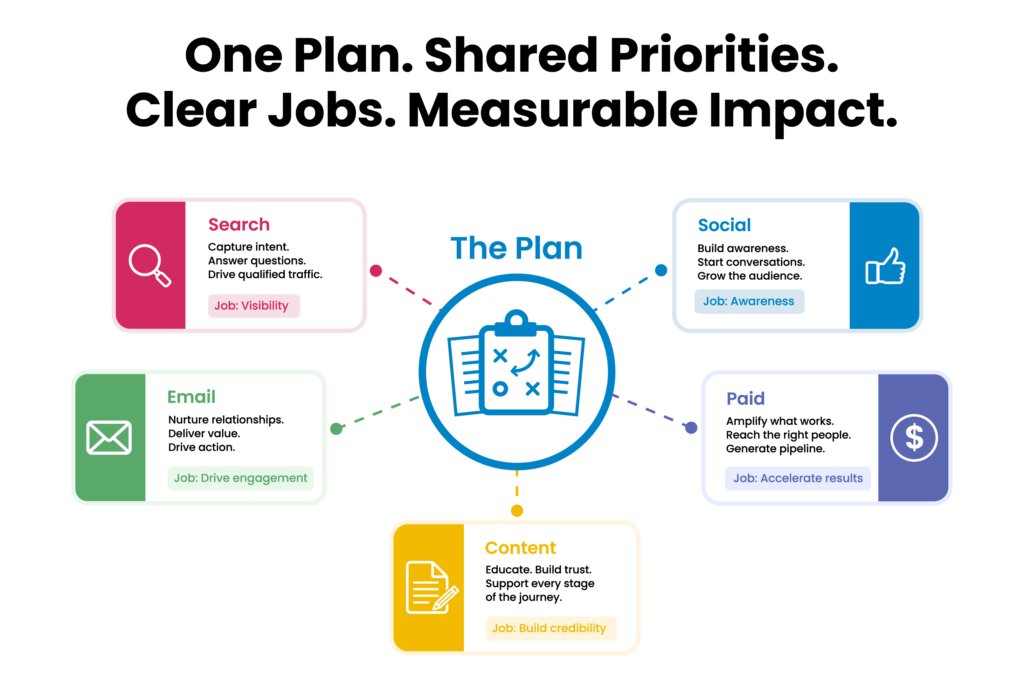
Most programs that struggle are not missing channels. They are missing a clear answer to a simple question: what is each channel supposed to do?
When every channel is running but nobody has defined its role, you end up with a lot of activity that is hard to defend and even harder to improve. Content goes out. Ads run. Emails get sent. But the connections between them and the sales pipeline remain fuzzy.
A program that holds up over time looks different. Each channel has a specific role in the buyer journey. The roles are defined before the work starts. And the reporting is built to show whether each channel is doing its job, not just whether it produced output.
Here is how those roles typically break down.
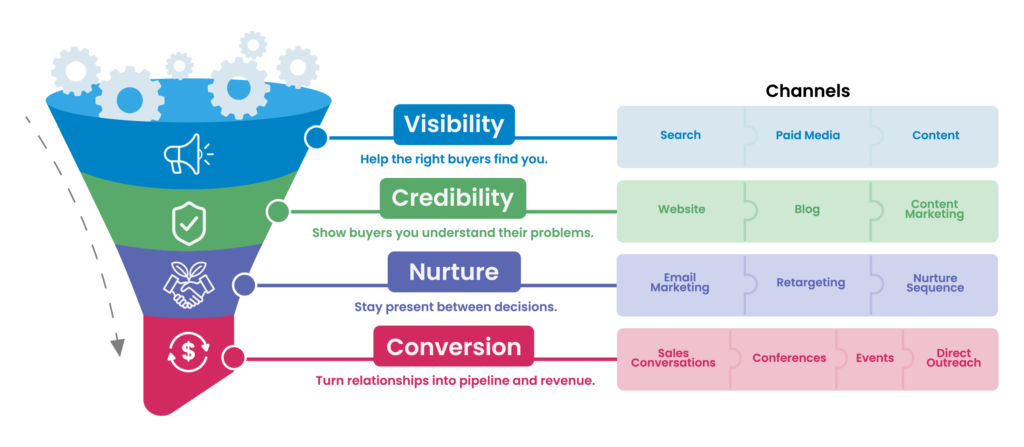
1. Channels That Build Visibility at the Top
Search (SEO, AEO, GEO), paid media, and content have one primary job: helping the right people find you before they are ready to buy. In changing industries, this layer needs regular attention.
- Search behavior shifts.
- Paid costs change.
- AI tools are surfacing answers in new ways.
Staying visible here is not a one-time setup; it is an ongoing discipline.
2. Channels That Build Credibility in the Middle
Your website, blog, and content marketing are doing the heavy lifting for buyers who are actively comparing options. By the time someone is reading your content or spending time on your site, they are forming a real opinion about whether you understand their problems. This layer needs to stay current.
Outdated content, stale messaging, and pages that no longer reflect what you actually do all quietly erode the credibility you built at the top.
3. Channels That Stay in Touch Between Decisions
Email marketing, retargeting, and nurture sequences keep you present with buyers who are not ready yet – and with customers you want to grow.
In long sales cycles, deals are won and lost in the gaps between conversations. It is also one of the most neglected layers in a thin team’s program because it rarely generates immediate, visible results.
4. Channels That Convert and Deepen Relationships
Sales conversations, conferences, events, and direct outreach are the places where relationships become revenue.
Marketing’s job is to make sure that by the time someone gets here, they already know who you are, what you do, and why you are worth their time. When the channels above are doing their jobs, this layer gets easier.
Putting It All Together
The goal is not to run all of these channels simultaneously and perfectly. The goal is to know which ones matter most to your buyers right now, give each one a clear job, and measure whether it is doing that job.
That is the difference between a marketing program and a marketing system. A program is running on channels. A system is channels with defined jobs, connected to a strategy, and measured against what actually matters to the business – pipeline and revenue, not just output.
Running the Program Under Real Constraints
A system is what makes a multi-channel program sustainable. Not because it makes execution easier, but because it gives your team a stable foundation to work from when the conditions around it change.
And they will change. Budget gets cut. A team member leaves. Leadership shifts priorities. The business pivots. None of that disappears. The question is whether your program has enough structure to absorb it, or whether every disruption becomes a reason to start over.
Here is how a system-backed program handles the most common constraints sales-led teams run into.
Running the Program with a Small Team
Most sales-led organizations do not have a large marketing department. One or two people are often responsible for everything – strategy, execution, reporting, and fielding requests from sales and leadership at the same time.
A system does not solve the headcount problem, but it does solve the prioritization problem. When channels have defined jobs and work is connected to clear goals, a small team can make better decisions about what to focus on and what to let go.
Learn More: What to Keep In‑House vs Hand Off with a Small Marketing Team.
Running the Program on a Tight Budget
A constrained budget does not mean a weak program; it means a program that has to be built around choices rather than trying to do everything.
The teams that get the most out of a tight budget are the ones who know which channels are doing the most work for their buyers and concentrate there. A system gives you the framework to make those calls with confidence instead of guessing.
Using AI Without Losing Brand Consistency
AI tools can help a thin team produce more, but only if there is a clear strategy behind them. Without it, AI accelerates inconsistency. Every team member is using different tools, generating different content, making different decisions, and none of it adds up.
A system gives AI a job to do: execute the strategy that is already defined, in the voice that is already established, against the goals that are already set.
Managing the Program with Contractors
Contractors and agencies can expand what a small team can do. They can also fragment a program quickly if they are not working from the same plan.
When contractors have clear channel roles, defined deliverables, and a shared understanding of what success looks like, the work stays connected. Without that structure, coordination becomes its own full-time job.
How Marketing Refresh Designs and Runs the Program
At this point, the question is not whether your industry is changing or whether your program needs to flex. It is who can help you build a system that holds up when it does. This is where Marketing Refresh fits in.
We Start From Your Strategy, Not From a Channel
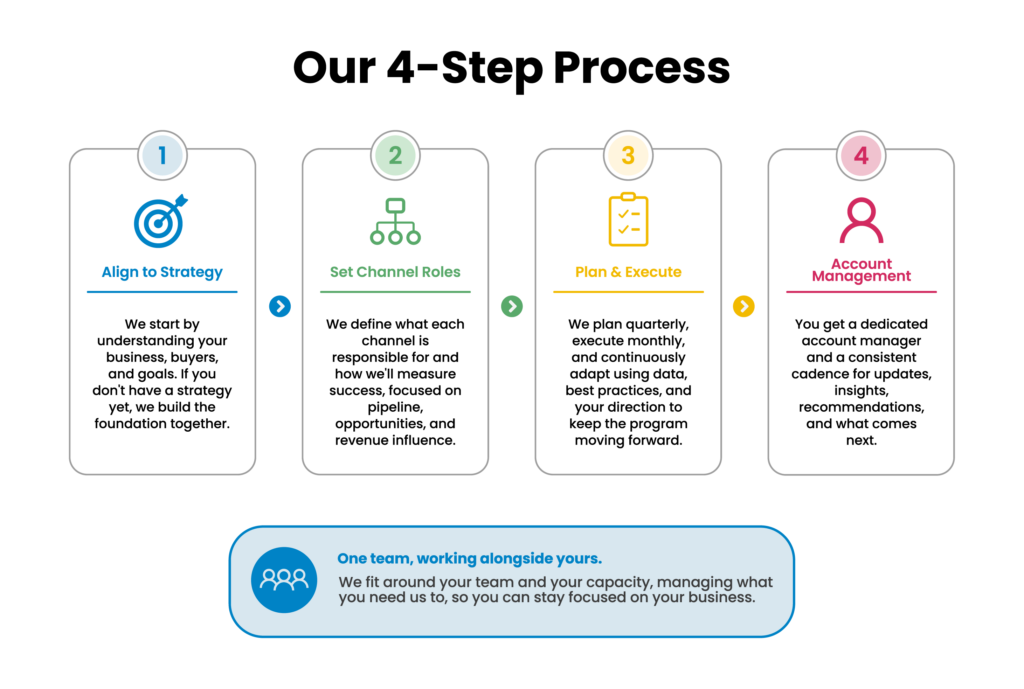
Every Marketing Management engagement starts with the discovery process to learn about your business, current marketing strategy, ideal buyers, and strategic business priorities. That means every channel we manage has a clear job before the first piece of content is written or the first campaign goes live.
If you haven’t developed a marketing strategy, that is where we start: with a Marketing Strategy & Blueprint engagement that gives your team, your sales leadership, and your marketing program a shared foundation to work from.
We Give Each Channel a Defined Role and a Way to Measure It
Before we execute, we define what each channel is responsible for – awareness, demand generation, nurture, or conversion – and how we will measure whether it is doing that job. Not impressions or open rates. Rather, pipeline, qualified opportunities, and revenue influence. That clarity is what separates a reporting conversation from a negotiation.
We Plan, Execute, and Keep Adapting
We are built to work in tandem with your internal team, filling necessary gaps so the program can keep moving.
We build quarterly plans with monthly deliverables, then work in partnership with the internal marketing team and other consultants to execute the work — content, campaigns, search optimization, paid programs, email, and more — across the channels you have prioritized. We do not hand you a plan and disappear.
Throughout the program, we use analytics and AI-supported tools to surface what is working and what needs to change. Then we use metrics, best practices, and your direction on the strategic business goals to decide where to focus.
Learn more about our approach to Analytics & Reporting.
You Have a Dedicated Account Manager and a Regular Cadence
You are assigned a dedicated Account Manager who meets with you on a consistent schedule to keep deliverables on track, review performance, share what we are learning, and recommend what to start, stop, or adjust. No surprises. No scrambling before a meeting. Just a regular, honest conversation about how the program is doing and what comes next.
We Fit Around Your Team, Not the Other Way Around
Some clients ask us to manage multiple channels – content, search, paid, email, and more. Others start with one or two where they feel the most pressure. We help you prioritize based on your growth goals, your internal team’s capacity, and where we think the next best opportunities are.
For teams with limited capacity, we can handle most of the day-to-day work. For others, we step into the channels or responsibilities your team cannot comfortably cover, without displacing the people and relationships you have already built.
Where to Start If This Is Hitting Close to Home
If your multi-channel marketing program is running but you are not sure it is keeping up with your industry, capacity, budget, or business, there are a few good ways to get started.
- Get a clearer strategy behind the program. If your strategy has not kept pace with how the business has changed, Marketing Strategy & Blueprint is where we start, so that everything your team executes has a clear purpose and direction.
- Get the right help running it. If the program is outrunning your team’s capacity, Marketing Management is how we keep the work moving, optimized, and connected to results.
- Find out where the gaps are. If you are not sure what is working, a Brand Audit gives you an honest look at where your story and presence stand today and where they need to go.

Ready for a Refresh?