
Rethinking Sales and Marketing Alignment in an AI World
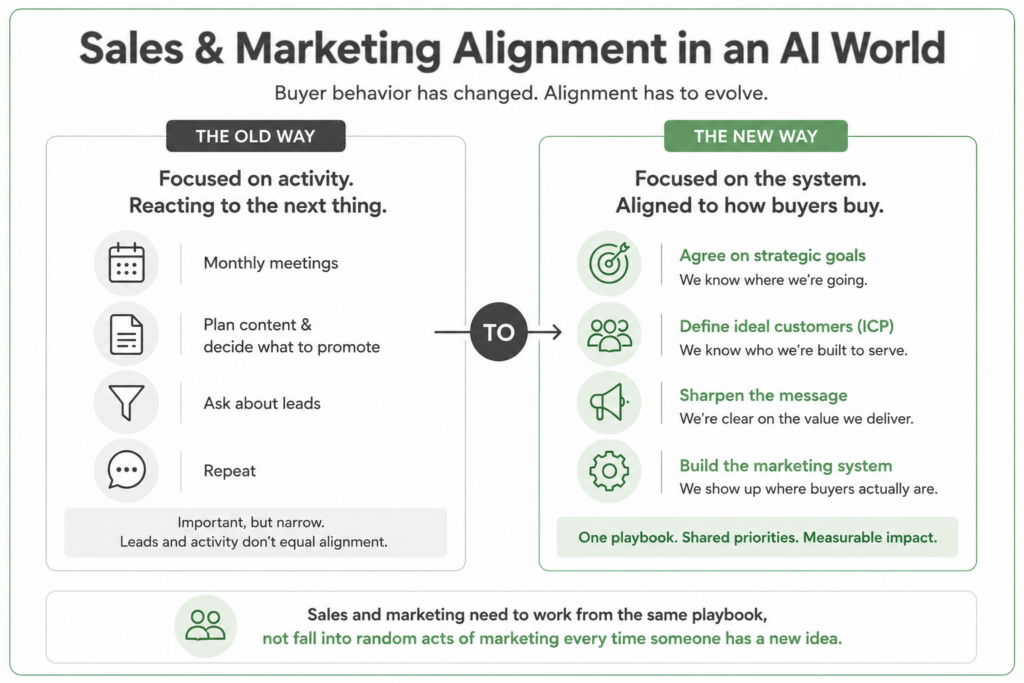
In a lot of sales-led companies, “sales and marketing alignment” still means a monthly meeting to talk through content, decide what to promote next, or ask whether marketing is sending enough leads. Those things still matter. They’re just not enough anymore.

Buyer behavior has changed. Today, people do more of the work on their own before they ever talk to sales. They use Google, Perplexity, Claude, ChatGPT, Copilot, and other platforms to research problems, compare vendors, and figure out who seems credible.
So now, working well together means something bigger. It means agreeing on strategic goals, defining your ideal customers, sharpening your message, and building a marketing system that reflects how buyers actually move across people, platforms, and AI tools.
In other words, sales and marketing need to work from the same playbook, not fall into random acts of marketing every time someone has a new idea.
Why This Conversation Has to Change to Support Sales and Marketing
For years, “sales and marketing alignment” focused on the visible stuff: conferences, campaigns, and lead counts in the CRM. Teams decided what to promote, where to show up, and how many leads to send to sales.
But the way buyers make decisions now is messier, less linear, and much harder to see. They still go to conferences, talk to peers, and read industry publications. But they are also:
- Searching Google to better understand their problem
- Asking AI tools to summarize vendors and buying criteria
- Checking LinkedIn to see who feels credible
- Comparing options on company websites and review sites
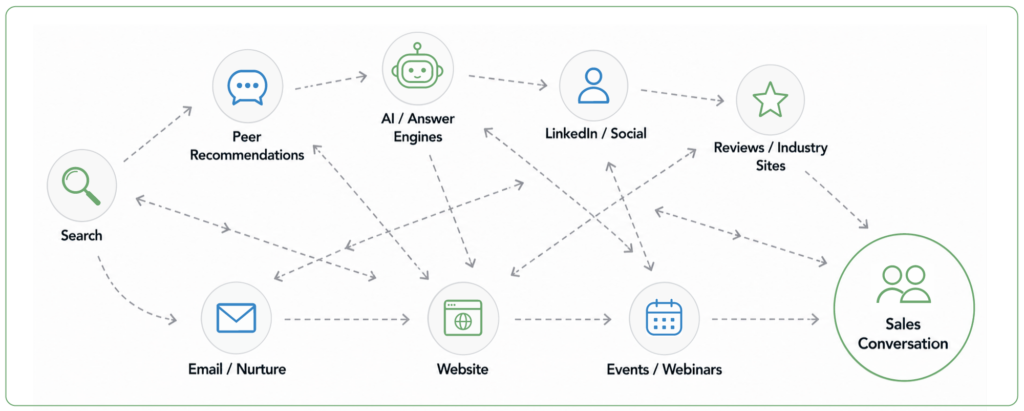
By the time they reach out, many buyers have already made the biggest decisions. Recent research shows that B2B buyers finalize 70% of their pre-qualification requirements before ever speaking with sales. In real life, that means they have often already moved through the early “Know” and “Like” stages, built a shortlist, and created a story in their mind about what you do, how you compare, and whether you are worth their time.
If sales and marketing are only aligned around campaigns, events, and lead volume, and not around business goals, buyer pain points, positioning, and the way buyers actually research and build trust across multiple touchpoints, marketing can stay very busy without becoming reliably effective.
And that is usually when marketing starts to feel scattered instead of strategic.
5 Signs You’re Stuck in Random Acts of Marketing
Not sure where your company falls on the scale of being strategic vs. scattered? Let’s take an inventory.
Marketing is Reacting to Siloed Feedback
Different departments are sending requests to marketing instead of working from a shared strategy. When teams are not aligned on business goals, messaging, and priorities, there is no real consensus. Leadership sees activity, but not a clear picture of how marketing is helping drive revenue.
Different Teams Are Testing AI In Isolation
One person is using ChatGPT to draft emails. Someone else is using Claude for keyword research or SEO copy. Maybe another tool gets added next week because apparently we all need more tabs open. The problem is that none of it ties back to a consistent brand message, voice, or strategy.
You Cannot Clearly Explain What Is Working
If business objectives and the supporting marketing strategy are not defined, reports tend to become pages of impressions, visits, and open rates without a clear connection to qualified opportunities, deals, or sales velocity.
The Story Changes Depending On Who is Telling It
Sales explains your value one way. Marketing says it another way. The website tells its own version. Buyers are left piecing together a mixed message about who you are, what you do, and why they should care.
Every New Tool Becomes a Test With No Real Conclusion
You try new platforms, AI tools, and tactics, but without a clear framework, it is hard to know what to keep, what to drop, and what is actually worth scaling.
Why You Need a System to Achieve Sales and Marketing Alignment in the World of AI
If you have ever had a content calendar and still felt like marketing was somehow all over the place, you are not alone.
A plan by itself is not enough. Without a shared system and strategy behind it, a calendar just becomes a more organized list of things to do.
What works better is a system your team can actually use and return to. That system should include:
- Strategic business goals set by leadership
- A clear way for sales and marketing to work together throughout the buyer journey
- A strategy for who you want to reach, what you want to be known for, and how you plan to win
- Tools, including AI, that help your team execute consistently without burning everyone out
When those pieces are clear, it gets a lot easier for everyone to row in the same direction. Leadership, sales, and marketing can all answer the same questions:
- What are our priorities for the next 12 months, starting with the next quarter?
- Who are our best-fit buyers, and how do they actually do their research?
- What problems do we want to be known for solving?
- What research do we need to understand how we should show up in search, on our website, and inside the tools buyers use to compare options?
- Which metrics actually tell us whether marketing is helping pipeline and revenue?
With a shared picture, marketing stops feeling like a stream of disconnected requests and starts acting like a real system. New ideas, channels, and tools all run through the same simple filter: does this support the strategy, and can we see how it helps buyers move forward?
So where does AI fit in? It is part of the stack. Not a replacement for strategy. Not a magic shortcut. When your objectives, system, strategy, and plan are clear, AI becomes a useful layer to help you show up more consistently across SEO, GEO, and AEO.
How We Design and Run the System
At this point, the question is not whether you need more marketing activity, but who can help you build a system that makes it all work together. This is exactly where Marketing Refresh fits in.
System & Blueprint
Marketing Strategy & Blueprint is where we turn your goals, buyers, and sales reality into a marketing system you can actually use.
We help you get clear on who you are trying to reach, what you want them to know and do, how marketing should support sales, and what each channel should be responsible for in driving pipeline.
The result is a documented blueprint that leadership, sales, and marketing can all point to when the question comes up: “What is our marketing actually supposed to be doing for the business?”
Marketing Management
Marketing Management is how we help you resource the system, measure performance, keep the work on track, and, for clients who want it, run the ongoing program.
That includes helping you identify the right mix of people, core marketing tools, and emerging AI tools, then making sure each one is being used in a way to support the bigger plan.
From there, we work with you to decide what your team should own and where Marketing Refresh should step in to manage or support execution. That way, the work stays connected to strategy, channels have clear jobs, and reporting focuses on qualified leads and opportunities, not just a pile of activity.
For teams with limited capacity, that may mean we handle most of the day-to-day work. For others, we step into the channels or responsibilities your team cannot comfortably cover.
Giving Each Channel a Clear Job
If it feels like your company is showing up everywhere, search, ads, social, email, events, and yet it is still hard to tell what is actually helping deals move forward, you are not alone.
- Website & Blog: Help buyers understand who you are, what you do, and what to do next.
- Content Marketing: Explain problems and solutions in ways buyers can find, understand, and use.
- Search (SEO, AEO, GEO): Help qualified buyers discover and shortlist you when they are actively looking for answers.
- Social Media: Stay visible where your buyers already spend time, share perspective, and build trust.
- Paid Media: Put focused messages in front of the right audiences to create awareness and generate workable leads.
- Email Marketing: Stay relevant between big decisions and remind prospects and customers of the problems you solve.
- Conferences & Events: Turn interest into real conversations and strengthen relationships through in-person touchpoints.
- Podcasts & PR: Share your point of view and customer stories in places buyers already trust for ideas and validation.
- Spanish Marketing: Help Spanish-speaking buyers connect with your business in their language as part of the core strategy, not as an afterthought.
Next Steps to Introduce Marketing as a System
In an AI-driven buying environment, true sales and marketing alignment means building a shared strategy, message, and system around how your customers actually research, compare, and decide. If you suspect there is a gap between leadership, sales, marketing, and the budget needed to support everyone, there are a few good ways to start:
1. Talk about Marketing Strategy & Blueprint. If you do not have a clear, shared plan for how marketing supports revenue, we will help you map your goals, buyers, and sales reality into a system leadership can actually stand behind.
2. Talk about Marketing Management. We can help you identify the right resources (internal, external, and tools) to manage the strategy and keep the system running well. For clients who want ongoing support, we can also help deliver content, search, paid, email, and more.
3. Request a Brand Audit. If you are not sure where to begin, a Brand Audit can show you how your current story and market presence compare to the story you want buyers to hear as they move through the decision-making process.

Ready for a Refresh?
"*" indicates required fields